Here are some of my favorite books and some other books that I don’t like at all but which are important to read.
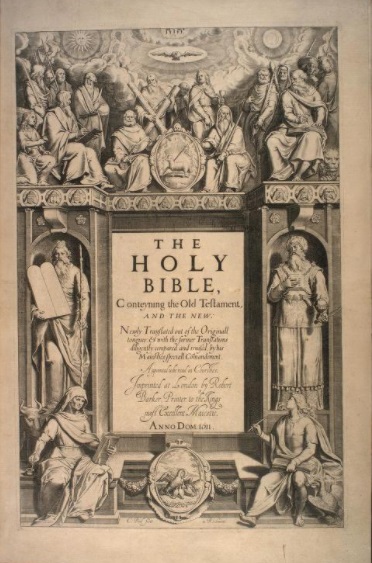
the Bible
The Bible, whether it’s the 1611 King James Version or the New International Version, the Bible is top on my list of favorite books. I’ve read from the Bible for most of my life it wasn’t until I had read it cover-to-cover a couple of times that I really began to understand and appreciate what is in the Bible. When I made reading the Bible a part of my daily routine, that is when I became a better husband and a better father. The Bible is so much more than a book of rules. It is the ultimate epic love story. It shows us God’s love for his children and it shows his children how to love one another. The Bible is the best.
My favorite Bible app is Olive Tree.
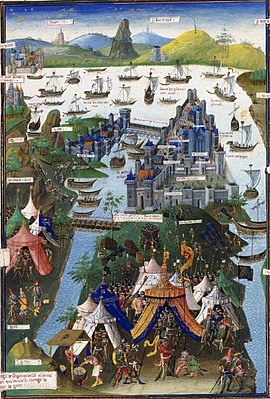
The History of the decline and fall of the Roman Empire
By Edward Gibbons 1776
Gibbons begins at the founding of Rome and walks us through its rise to become the world empire. What struck me most was just how cheap and cruel life was before Christianity. Rome reached its zenith around the time that the New Testament was being written, maybe shortly after. As Christianity grew, Rome declined. But we also see how the political intrigues of Rome infected the church and when Muslims conquered the Middle East and North Africa, the church instead of wielding the sword of the Spirit, sent crusaders with swords of steel, to fight a worldly war with worldly weapons. Constantinople fell in 1453, ending Gibbon’s history of Rome. Gibbon’s is primarily a secular, not an ecclesiastical history so what he doesn’t mention is that in those final days of the Roman empire, the church was in a very sorry state. But the reformation was beginning, which would bring in a much-needed spiritual awakening.
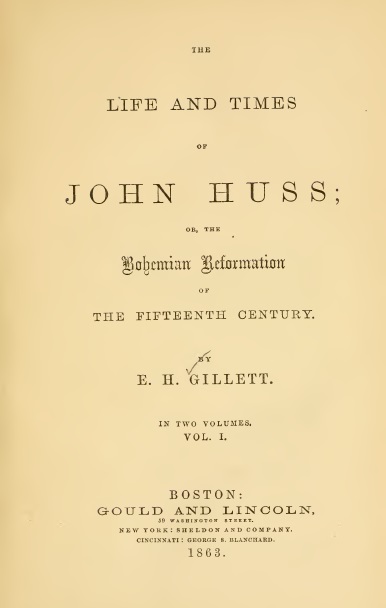
The Life and times of john huss or the bohemian reformation of the fifteenth century
By E. H. Gillett 1863
In the final days of the Roman Empire, the wealth, power, and corruption within the church was beyond belief. While powerful men were fighting for political control of the church, a few others were fighting the good fight for the souls of men. John Huss was one of the early reformers. 100 years before Martin Luther, John Huss preached in Bethlehem Chapel in Prague. He read what “the heretic” John Wycliffe had written, just to see what all of the fuss was about. He actually agreed with Wycliffe that the Bible should be the ultimate authority in all spiritual matters and so he preached. The power-hungry church leaders didn’t like that. His bravery and love for truth is inspiring while the lengths that his enemies went to in order to retain power is deeply disturbing. Then the way his followers fought after he died is simply heart breaking. In many ways, it’s as though they had not listened to him at all.

Paradise Lost
By John Milton 1667
John Milton’s Paradise Lost is a masterpiece. The story of the fall in Genesis 3 is sad indeed but the way Milton tells it is heartbreaking. I had to fight back tears when Eve ate the fruit. But there is hope. Man lost the paradise that God made for him but God has a plan for bringing him back. I have to read it again this year. Milton wrote the poem in 1667. In 1866, Gustave Dore’ published Paradise Lost with his own magnificent illustrations like the one above.
I have this version from Arcturus press and I love it. This looks like a good free version at archive.org.
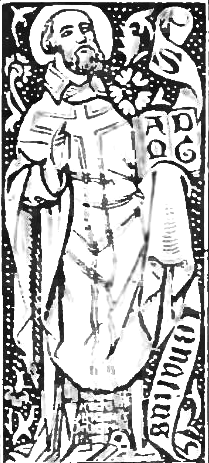
The Apostolic Fathers
The Apostolic Fathers were Christians of the second century who had known the apostles themselves or were taught by someone who had known the apostles. From them we get an idea of what the church in the second century looked like and how those early Christians understood the scriptures. There is a good set of PDFs containing the Apostolic Fathers in the Ante-Nicene Christian Library on archive.org. This contains many Christian writings before the council of Nicaea. One thing that I didn’t notice in this set was the Didache, an interesting summary of Christian teachings from the second or early third century. But you can find the Didache at CCEL.org in English or Greek .
If you want to read the Apostolic Fathers in Greek, the Loeb Classical Library from Harvard University Press has a two volume set with some of the second century writings. The Loeb books have the Greek text on the left page and an English translation on the other. The most recent edition of the Apostolic Fathers was edited and translated by Bart D. Ehrman and is available on Amazon. Archive.org has free scans of a 1917-18 edition here: Volume 1, Volume 2. There are other volumes for other authors.
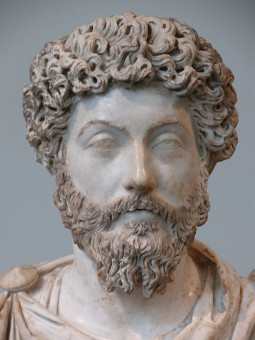
The Meditations of the Emperor Marcus Aurelius
By Marcus Aurelius
Marcus Aurelius, emperor and Stoic philosopher, ruled Rome from 161 to 180 AD. He was the last of the five good emperors, though he was not always all that good to Christians. Justin Martyr wrote to him and tried to convince him that he would like Christianity if he would look into it more. I think Justin Martyr was right because many of his ideas in Meditations fit well with Christian teachings.
You can find Justin Martyr’s apologies in the Apostolic Fathers.
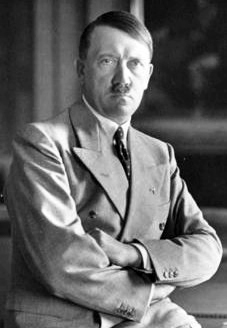
Mein Kamph
By Adolf Hitler (BOO!)
Not a fun book to read but it does help to understand the mind of an evil man and how he manipulated a nation. Moved by resentment and hatred, Hitler mastered the use of propaganda and envy to convince millions of others to blame wealthy Jews for most of their problems then plunder and persecute those convenient scapegoats to help build his National Socialist utopia. He was not an evil genius but he was certainly evil and he knew how to convince people to do very bad things. I bought a 1939 copy at an antiques store and it sat on my self for about a decade before I opened it. I will probably never open it again.
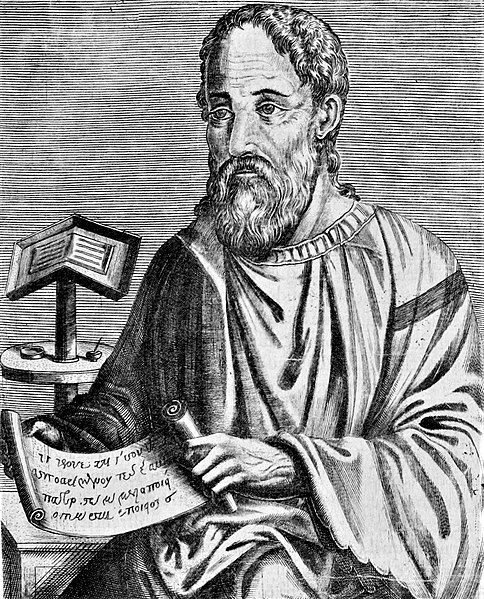
Ecclesiastical History
By Eusebius Pamphilus ~325
Eusebius Pamphilus, bishop of Cesarea wrote a history of the Christian church from the time of Christ to the Council of Nice. Eusebius records many local persecutions throughout the Roman Empire and how Christian faith and bravery gradually prevailed. One event that fascinates me is how during a plague in Alexandria, Egypt, when many were tossing their sick and dying relatives out on the street to die, Christians took them in and cared for them, knowing that they would soon catch the disease and die themselves. It was that kind of gentle compassion in the early days of the church that overcame Roman abuse and aggression. You can find a free PDF on archive.org here: Ecclesiastical History.
Some other books that I like:
The Republic by Plato
Apology of Socrates by Plato – Socrates didn’t claim to be wise, he was just looking for wisdom.
Uncle Tom’s Cabin by Harriet Beecher Stow
Black Rednecks and White Liberals by Thomas Sowell
Discrimination and Disparities by Thomas Sowell
Grant by Ron Chernow – a biography of Ulysses S. Grant
A Brave New World by Aldous Huxley
Darwin’s Doubt by Stephen Meyer – Charles Darwin knew that there were some holes in his theory but thought that in time, those would be resolved. That has not been the case because the more we know about life, the less plausible Darwin’s theory has become.
The Cost of Discipleship by Deitrich Bonhoeffer
Bonhoeffer: Pastor, Martyr, Prophet, Spy A Righteous Gentile vs. The Third Reich by Eric Metaxax
Seeking Allah, Finding Jesus by Nabeel Qureshi
Martin Luther by Eric Metaxas
Amazing Grace: William Wilberforce and the Heroic Campaign to End Slavery by Eric Metaxas
Other books that are good to read but not fun to read:
The Gulag Archipelago by Aleksandr Solzhentsyn – shows how cruel mankind can be when they are trying to protect a bad ideology.
The Rise and Fall of the Third Reich by William I Shirer – shows how cruel mankind can be and how fortunate we are that Hitler was too arrogant to let his generals run the war.
A Brief Account of the Destruction of the Indies by Bartolome de la Casas – A horrific description of the Spaniards’ treatment of Native Americans in the late 15th and early 16th century. Bartolome de la Casas is called the Apostle to the Indies (America) because after seeing the poor treatment of the Native American people by the Spaniards he dedicated his life to abolishing slavery in the Americas. He preached the first abolitionist sermon in America.
The Koran by Mohammed – I don’t think this is the inspired scripture that many think it is. I think the reason there are so many nice Muslims and so many mean Christians is because so few actually read their holy books.
Many of these books are available for free either from Project Gutenberg or from archive.org.
 Figuring It Out
