
This is not so much a “How to learn Greek” guide as it is a “How I’m learning Greek” testimonial. I hope you find some of it useful.
I’m a computer programmer, not a preacher. Well, sometimes I have filled in at my local congregation and I teach Bible class; but I’m a total layperson and a total nerd. My Greek journey started about 20 years ago when I saw a book titled “Teach Yourself New Testament Greek” in a discount bookstore and bought it on a whim. I worked through a couple of chapters but having always struggled with rote memorization, I got frustrated trying to learn the vocabulary and declensions and laid the book aside for a year or so. I would pick it up from time to time and try again but still got frustrated and set it aside for a week or a month or a year. This went on for about ten years and I didn’t make much progress. I did take an introductory Greek class at a local Bible school and got just a little farther than I had gotten on my own. Then, I found Daily Dose of Greek where Dr. Robert Plumber had recorded lectures for each chapter in David Alan Black’s book, “Learn To Read New Testament Greek.” That was exactly what I needed to jumpstart me. I describe the Daily Dose in more detail below. Since then, I have found quite a few free and inexpensive and fun (nerd fun that is) resources that have helped me in my efforts to learn to read the Greek New Testament.
Ever since I first bought that book at the discount bookstore, I just couldn’t shake the urge to learn Greek. I don’t think we need to know Greek to be a good Christian or a good Bible student or an excellent teacher. It’s just something that I find interesting. I also don’t know that knowing Greek makes you a better Christian. But the process of learning Greek has helped me understand God’s word more fully simply because I spend more time in the word. I think whatever draws you into the word of God, that’s a good thing. For me, that thing is learning the Greek language.
Here are a few of the resources that have helped me the most. I will try to add more resources to this page when I can.

Daily Dose of Greek has been a huge help. I tried to learn Greek on my own for a few years but became frustrated and quit several times because I didn’t have the answers to the exercises and I didn’t really know how to pronounce the words. Then I found DailyDoseOfGreek.com. In the Learn section, Dr. Robert Plumber gave a lecture for each chapter in the David Alan Black’s, “Learn To Read New Testament Greek” book. The lectures were just what I needed and the answers to the exercises were in the back of the book. I completed that book then moved on with Black’s Intermediate grammar, “It’s Still Greek to Me.” Since I worked through the lectures at Daily Dose, Dr. Plumber has updated the videos and is now using the “Beginning New Testament Greek” text book. I’m sure it’s great.
The best thing about Daily Dose of Greek is the daily videos. Every week day, Dr. Plumber records about a three minute video, analyzing one verse in the Greek New Testament. I’ve made watching the Daily Dose video a part of my daily routine. The Daily Dose phone app, available for free in the Google Play store, makes that especially easy. The daily dose reinforces what I have learned so far, usually shows me something new, and always gives me a better appreciation for God’s word.
Read, Greek
Just start reading. Even if you struggle through one verse a day, do it. Make notes, copy the verse on a post-it note or index card and look at it from time to time. It will help build vocabulary and recognize word forms. I found John to be the easiest to read and Luke the hardest. I started with Matthew, and John was a refreshing break. Then, when I got to Revelation, I was actually able to read a few verses before having to look up a word. Maybe the greatest benefit I found from reading the Greek New Testament is that I read so slowly, because I was so bad at it, that I had much more time to think about each phrase in each verse. I didn’t really get much more out of the text because I knew the Greek. I got much more out of the text because I slowed way down as I learned to read it in Greek.
GA 8 11th Century Miniscule
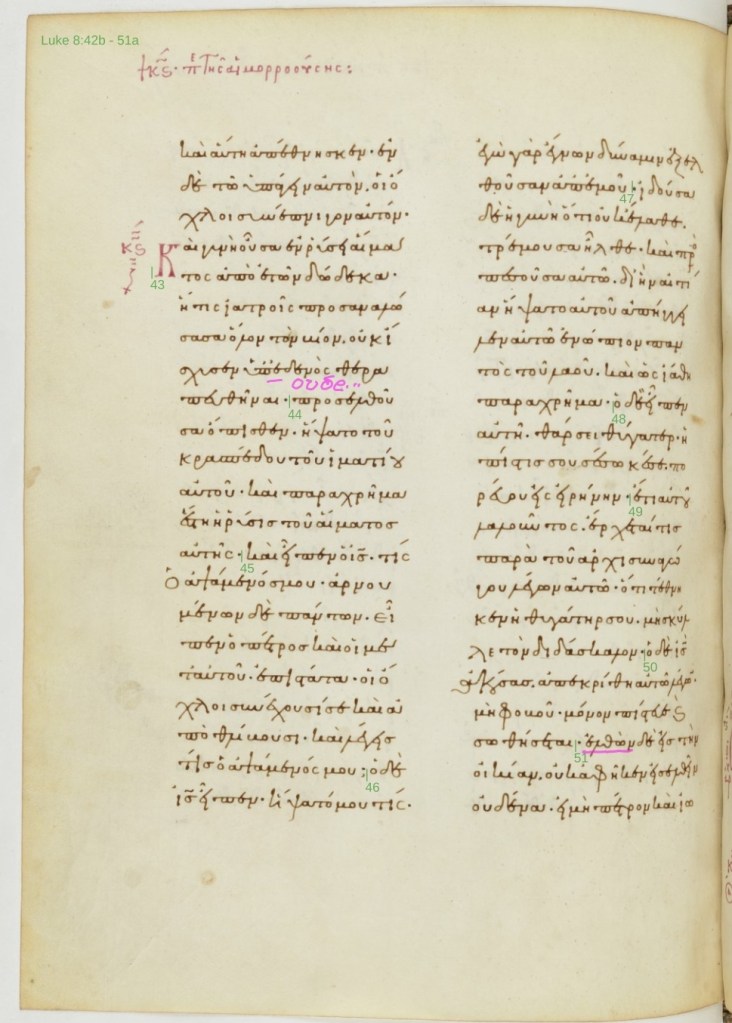
GA 8 is an 11th century, Byzantine miniscule that I’ve been reading to learn how to read Greek miniscules. 11th century Greek script is more difficult to decipher than earlier majuscules, at least the neat ones, a lot of the papyri are pretty tough to read. The Vatican has a brief description of miniscule writing in the miniscule bookhands section of their Greek Paleography page that helps to get started with miniscules. I like GA 8 because it’s fairly early for miniscule texts, it’s neatly written, and it is in good condition. I muddle through a few verses at a time and mark it up in my ebook reader, usually just marking the beginning of each verse, but sometimes marking interesting variant.
Wikipedia has a description of GA 8 at https://en.m.wikipedia.org/wiki/Minuscule_8. The manuscript is at the French National Library in Paris. You can view it and download a PDF file of part of all of the manuscript from their website. https://gallica.bnf.fr/ark:/12148/btv1b8470447s/f1.image.r=.langEN. You can see individual pages at CSNTM.
The GA 8 miniscule is not to be confused with GA 08, Codex Laudianus, a 6th century Greek-Latin diglot of Acts.
Codex Vaticanus

Codex Vaticanus is another of our oldest complete Greek Bibles. It was originally copied in 300-325 AD, then retraced probably in the 10th or 11th century, where punctuation and breathing marks were added.
You can view high quality images of Codex Vaticanus at the Vatican digital library https://digi.vatlib.it/view/MSS_Vat.gr.1209. The menu for jumping to a particular book is in Latin but it’s easy enough to figure out. Sorry, you can’t jump to a particular chapter and verse. So, part of the fun of reading old manuscripts if figuring out where you are and from there trying to find where you want to go.
Greek Polytonic Keyboards
Greek Polytonic keyboards let you type in Greek with breathings and accents.
Here is are some good instructions for installing and using a Greek Polytonic keyboard in Windows 10. https://www.ctsfw.edu/wp-content/uploads/2016/02/Greek-Unicode-Keyboard-Input-Windows-10.pdf
On Android, I use the Hoplite Polytonic Greek Keyboard available in the Google Play store. It works great.
BDAG Lexicon
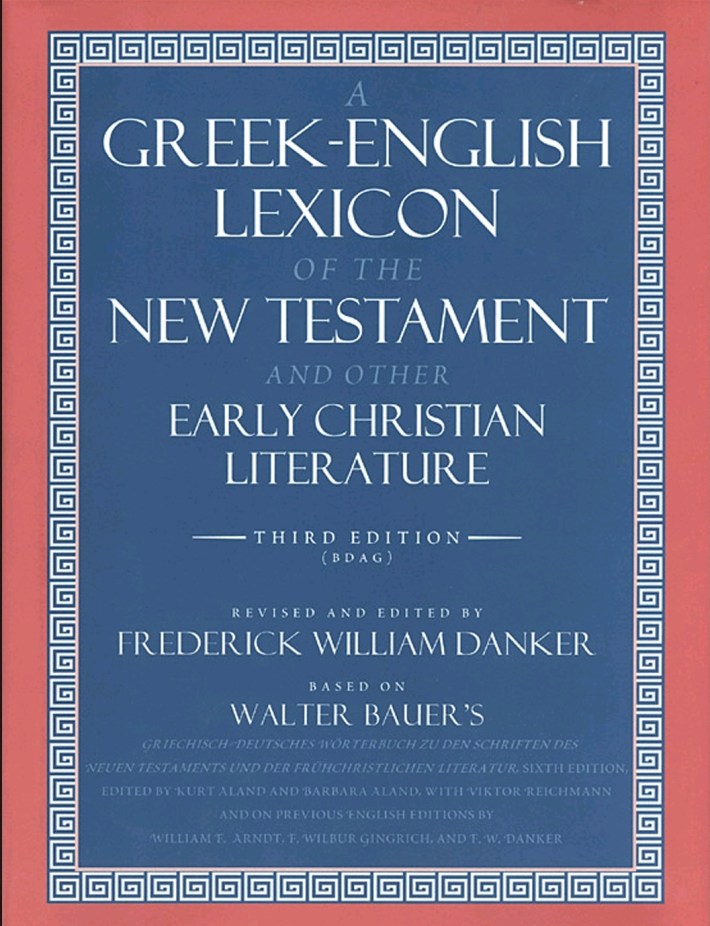
The BDAG lexicon is what I have heard recommended the most. But it’s expensive. Last fall Chicago press ran a sale where you could buy the PDF for $75. That’s a lot of $$ for a PDF file but I’ve been happy with it. I like the PDF because I can keep it on my phone.
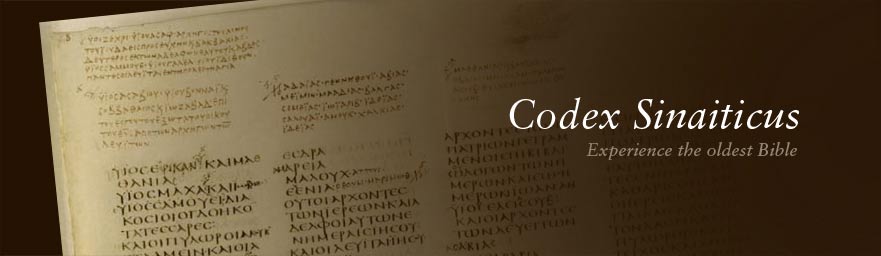
https://codexsinaiticus.org/en/
Codex Sinaiticus is perhaps our oldest complete Greek Bible manuscript. After learning how to read some Greek, you might want to browse through some old manuscripts. That can be difficult though, since there were no chapter or verse divisions and all the words run together. The cannon tables make that a little easier, if you know how to read them, but not much. (I’ll try to write something about that sometime). The Codex Sinaiticus website makes browsing that manuscript very easy. You can look up a passage by book, chapter, and verse and see the manuscript, a Greek transcript, and an English translation side-by-side. It works great from a desktop browser, but I haven’t been able to get zooming to work on a tablet or phone. The Majuscule text isn’t that hard to read, even though there are no spaces between words. The toughest part for me was figuring out that ‘Σ’ was actually written as ‘C’. But now you know that so it should be a breeze! It’s just way cool (nerd cool) to read an 1800 year old manuscript. Have fun!
Essentials of New Testament Greek
by John H. Huddilston
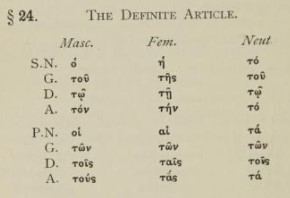
Essentials of New Testament Greek is just that, the bare essentials. I keep a copy on my phone and use the last half of the book as a reference for Greek paradigms; the noun declensions, verb conjugations, and such. It also contains a vocabulary list with very brief definitions of the most common words that are found in the Greek New Testament. The best thing about it is that it’s free. You can find it in Google Books or in archive.org.
SBLGNT Reader app for Android
The SBL Greek New Testament Reader App by Matt Robertson has been one of the most useful tools for me. It has the text of the SBL Greek New Testament. The best thing about it is when you touch a word it shows a brief definition with the parsing of that occurrence of the word, and concordance where you can see all other occurrences of that word in the Greek New Testament. Another nice feature is the Chapter Vocab which builds a list of the words in that chapter, with the number of occurrences for that word in the Bible and a brief definition of that word. It’s a great tool when you are trying to build your vocabulary.
The SBL Greek New Testament Reader is available for free with no ads in the Google Play store. THANK YOU Matt Robertson!
Olive Tree
I started using Olive Tree on my palm device. Remember Palm? I mostly use Olive Tree on my Android phone and Android tablet. The app itself is free and a lot of Bibles are free. You can buy Bibles too. They have sales all the time. What I really like is that I can highlight and make notes and those are shared across all of my devices. This is probably the tool that I use most for Bible study.
ESV Strong’s Bible cost $5 I think. That may have been on sale.
SBL Greek New Testament is free
Scrivener 1894 TR is free.
WYCLIFFE – that was fun to read.
Internet Archive

If the copyright has expired, you can probably find a pretty good scan of the book at archive.org. They have millions of free books and more.
Here are some fun ones:
Apostolic Fathers Volume 1 Volume 2
The Analytical Greek Lexicon
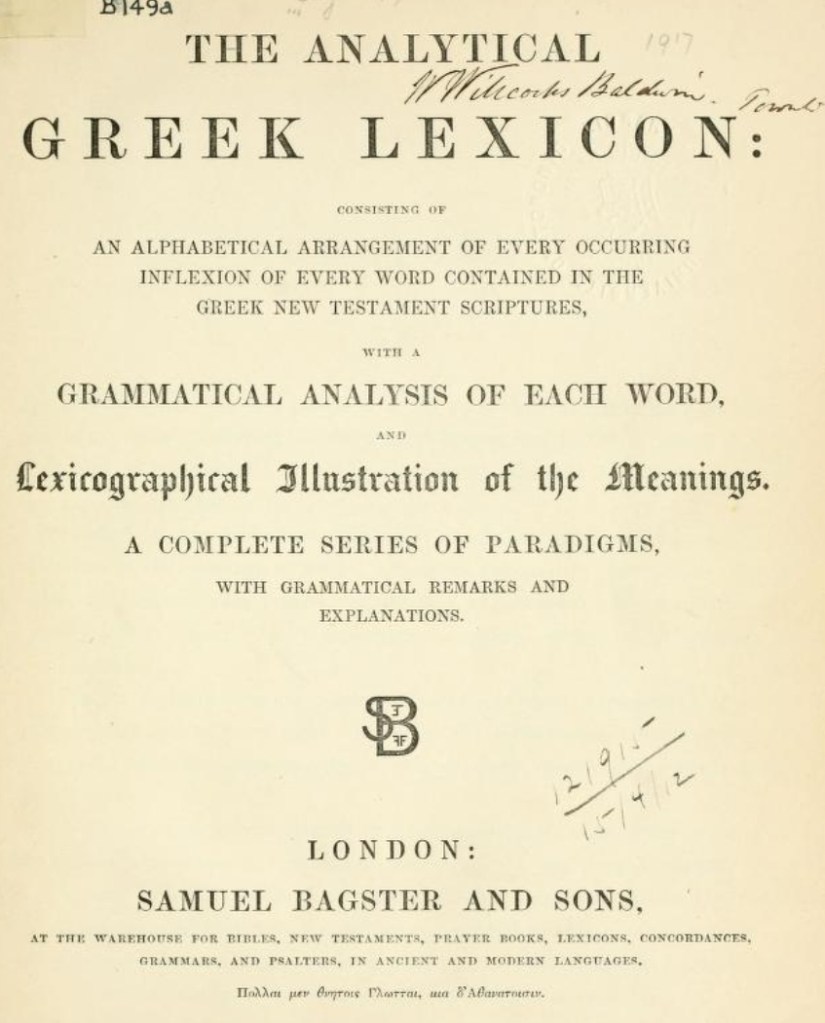
The Analytical Greek Lexicon has every form of every word as it appears in the New Testament. Eventually, you can recognize the root word and go straight to the BDAG or LSJ lexicon but especially at first, while you are still building up your vocabulary and learning the paradigms, this is very a useful tool when you just want jump in and read some Geeek.
I think Zondervan still publishes the Analytical Greek Lexicon. I run across them all the time in used bookstores. Archive.org also has several good scans.
Additional Resources
The Text of the New Testament by Kurt and Barbara Aland.
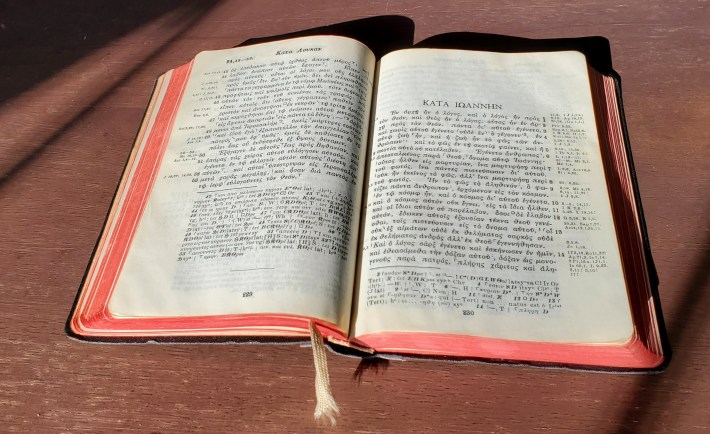
Novum Testamentum Grace; Nestle – Aland. I have the 27th edition and the 21st pocket edition (pictured at the top of the page.)
Greek Grammar Beyond the Basics by Daniel B. Wallace
The Text of the Earliest New Testament Greek Manuscripts; edited by Philip Comfort and David Barrett. This contains transcripts, some images, and background information of the earliest papyri P1-139. It also has a section on how manuscripts are dated.
A Reader’s Greek New Testament. There are a few different versions of this. I have the second edition by Goodrich and Lukaszewski from Zondervan. I think I bought it at Mardel. I like it. It has a dictionary in the back, containing words that appear more than 30 times in the New Testament. Words that appear fewer than 30 times are listed at the bottom of each page on which they appear in the order that they appear.
 Figuring It Out