
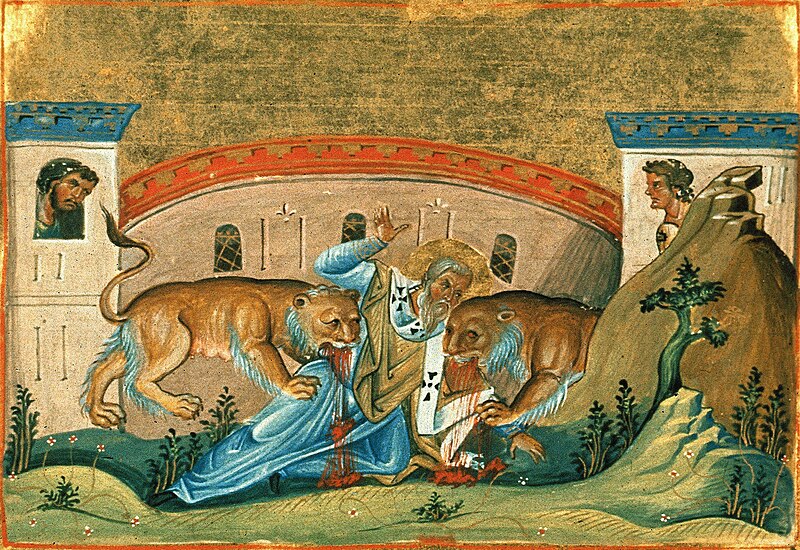
Thoughts on Ignatius to the Ephesians
Ignatius was a Bishop Antioch in Syria who was sentenced to be “fed to the beasts” in Rome. According to Eusebius, he was executed in 108 BC during the reign of Trajan (98-117 A.D.). On his way to Rome, Ignatius wrote letters to several churches who had helped him along the way, requesting their prayers, thanking them for their help, and encouraging them to remain faithful. Ignatius gives us first-hand glimpse into the second century church and his own extraordinary faith.
Oh What Faith!
While he asked for prayers on his behalf, he did not ask to be delivered from punishment but that he would remain strong throughout his trials.
For when you heard that I had been sent a prisoner from Syria for the sake of our common name and hope, in the hope of obtaining by your prayer the privilege of fighting with beasts at Rome, that by so doing I might be enabled to be a true disciple, you hastened to see me. (1:2)
Ignatius took James 1:2-4 seriously, “2 Count it all joy, my brothers, when you meet trials of various kinds, 3 for you know that the testing of your faith produces steadfastness. 4 And let steadfastness have its full effect, that you may be perfect and complete, lacking in nothing.”(ESV) It’s like he was eager to prove his faith and thought that his martyrdom would make him a true disciple. What extraordinary faith! We see similar strength of faith in Polycarp but whereas Polycarp seemed indifferent to suffering, Ignatius seems eager for it.
The Eldership
One interesting thing I noticed from Ignatius was that at that time (probably 108 A.D.) it looks like there was one bishop in Ephesus, Onesimus, along with a presbytery and deacons. Ignatius repeatedly encourages the church at Ephesus to obey their bishop. I don’t know if Onesimus was the only bishop in Ephesus or just the one bishop who came to visit him. Luke writes in Acts 20:17-38,that there were multiple elders in Ephesus when Paul met with them on his way to Jerusalem. It seems like it didn’t take very long for the leadership structure in the church to change. By the time Eusebius wrote his Ecclesiastical History, it seemed common for a single bishop to preside over the church in each city. But no bishop yet presided over more than the local congregation.
On How We Should Treat Others
Ignatius reminds the church at Ephesus and us about how we should treat others, especially those outside of the church.
Now for other men, “pray unceasingly,” there is in them a hope of repentance that they may find God. Suffer them therefore to become your disciples, at least through your deeds. Be yourselves gentle in answer to their wrath; be humble minded in answer to their proud speaking; offer prayer for their blasphemy; be steadfast in the faith for their error; be gentle for their cruelty, and do not seek to retaliate. Let us be proved their brothers by our gentleness and let us be imitators of the Lord, and seek who may suffer the more wrong, be the more destitute, the more disposed; that no plant of the devil be found in you but that you may remain in all purity and sobriety in Jesus Christ, both in the flesh and in the Spirit. (Ignatius to the Ephesians ch X)
This is timeless advice for all Christians. This is similar to what Jesus taught in the sermon on the plane in Luke 6:27-36:
27 “But I say to you who hear, Love your enemies, do good to those who hate you, 28 bless those who curse you, pray for those who abuse you. 29 To one who strikes you on the cheek, offer the other also, and from one who takes away your cloak do not withhold your tunic either. 30 Give to everyone who begs from you, and from one who takes away your goods do not demand them back. 31 And as you wish that others would do to you, do so to them… (ESV)
The Christian’s hope for everyone is “that they may find God” and there is always hope for repentance. One of the best ways, maybe the best way, to lead others to God is through our own deeds. After all, we were created for good works (Ephesians 2:10). For that to work, our deeds have to be attractive to those outside. We have to be blameless and harmless and we have to stand out in this crooked and twisted generation, shining as lights in a dark world (Philippians 2:14-16).
For Further Reading
The Writings of Ignatius can be found in the Loeb Classical Library, Apostolic Fathers Volume 1 and other collections of early Christian writers.
Ecclesiastical History by Eusebius Pamphilus contains a history of the church through the Council of Nice. Ch XXII introduces Ignatius. Ch XXIII and XXXI tells of the Apostle John’s death and his time in Asia. Ch XXXVI tells of Ignatius’ death.
 Figuring It Out
Leave a comment