The “like figure” that Peter spoke of is the water of the flood that saved Noah (1 Peter 3:20). Just as the flood waters saved Noah and his family, baptism saves us now. But you may recall that Paul wrote in Ephesians 2:8, “For by grace you have been saved through faith. And this is not your own doing; it is the gift of God.” If Paul says that we are saved by grace then why does Peter say that baptism save us? Then there is James 2:17-19, “So also faith by itself, if it does not have works, is dead. But someone will say, ‘You have faith and I have works.’ Show me your faith apart from your works, and I will show you my faith by my works. You believe that God is one; you do well. Even the demons believe—and shudder!” So who is right and what saves us: Peter and baptism or Paul and grace through faith or James and works?
Let’s think about Noah and the example that Peter gives us. Noah was saved by the water but only because he built the ark. He did the work and built the ark because he had faith in what God told him and what God told him to do. He knew he had to build the ark and how to build the ark and God waited for Noah to build the ark all because of God’s grace.
Grace, faith, works, and the waters of the flood all had a role in Noah’s salvation. For us, God’s grace provides a way for our salvation. Our faith moves us to obey the gospel call and submit to baptism. Then our works are evidence of our faith and love for the one who saved us. I think those works also help strengthen the bond between us, our Savior, and one another, thus further securing our salvation, for “the one who endures to the end will be saved (Matthew 10:22).
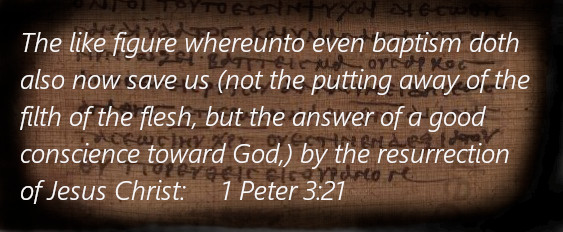
About the image:
P72 is a papyrus containing 1st and 2nd Peter and Jude. It was copied in the early to mid 3rd century (200-250 AD). You can see P72 at the The Vatican digital library here: https://digi.vatlib.it/view/MSS_Pap.Bodmer.VIII. Each page of P72 has a page number at the top. But instead of Arabic numerals, a Greek numbering system was used. Α=1, Β=2, Γ=3… Ε=5… Ι=10, etc. 1 Peter 3:21 is found on page ΙΕ (15) on the slide labeled 30-15. Page 30 (Λ) is on the left side. Page 15 (ΙΕ) is on the right side.
At that time when P72 was produced, writing was in all caps and they didn’t put spaces between words. They might put a space between a sentence or a thought. 1 Peter 3:21 starts on page 15, sixth line from the bottom. Here is a transcript of verse 21.
ϹΑΝ ΔΙ ΥΔΑΤΟϹ 21 ΚΑΙ ΥΜΑϹ ΑΝΤΙΤΥΠΟΝ
ΝΥΝ ϹΩΖΕΙ ΒΑΠΤΕΙϹΜΑ ΟΥ ϹΑΡΚΟϹ
ΑΠΟΘΕϹΕΙϹ ΡΥΠΟΥ ΑΛΛΑ ϹΥΝΕΙΔΗϹΕΩϹ
ΑΓΑΘΗϹ ΕΠΕΡΩΤΗΜΑ ΕΙϹ ΘΝ ΔΕ ΑΝΑϹ–
ΤΑϹΕΩϹ ΙΗΥ ΧΡΥ 22 …
The writing is sloppy compared to Codex Vaticanus (slide 1433, col 1, 12th line from the bottom) or Sinaiticus but it’s fun to figure out the lettering in different manuscripts. Hint: Ϲ=Σ. Also in the P72 image, notice the lines over ΘΝ, ΙΗΥ, and ΧΡΥ (I underlined in them in the transcript). That notation is nomina sacra, “Sacred name.” The scribes abbreviated the names of the deity in this way.
ΘΝ = ΘΕΟΝ God
ΙΗΥ = ΙΗΣΟΥ Jesus
ΧΡΥ = ΧΡΙΣΤΟΥ Christ
 Figuring It Out
Leave a comment